
Most AI companies are focused on speed.
Faster content. Faster responses. Faster automation.
But speed doesn’t solve the real problem organizations face: making better decisions under pressure.
That’s where Neural Nest AI is taking a different approach.
The first wave of AI generated outputs. The next wave is about something more valuable: systems that can evaluate, challenge, and refine decisions—like a team of experts would. Neural Nest AI is building multi-agent, knowledge-infused systems that simulate this kind of reasoning. Think less chatbot and more digital advisory board.
Nowhere is that shift more relevant than in legal arbitration—a system under increasing strain. Cases can take more than 60 days to resolve, costs continue to rise, and access remains limited. Through its collaboration with University of Maryland Baltimore County, Neural Nest AI is helping develop ARTHEMIS, an AI-enabled virtual courtroom platform designed to fundamentally rethink how disputes are resolved.
A Real-World Problem Worth Solving
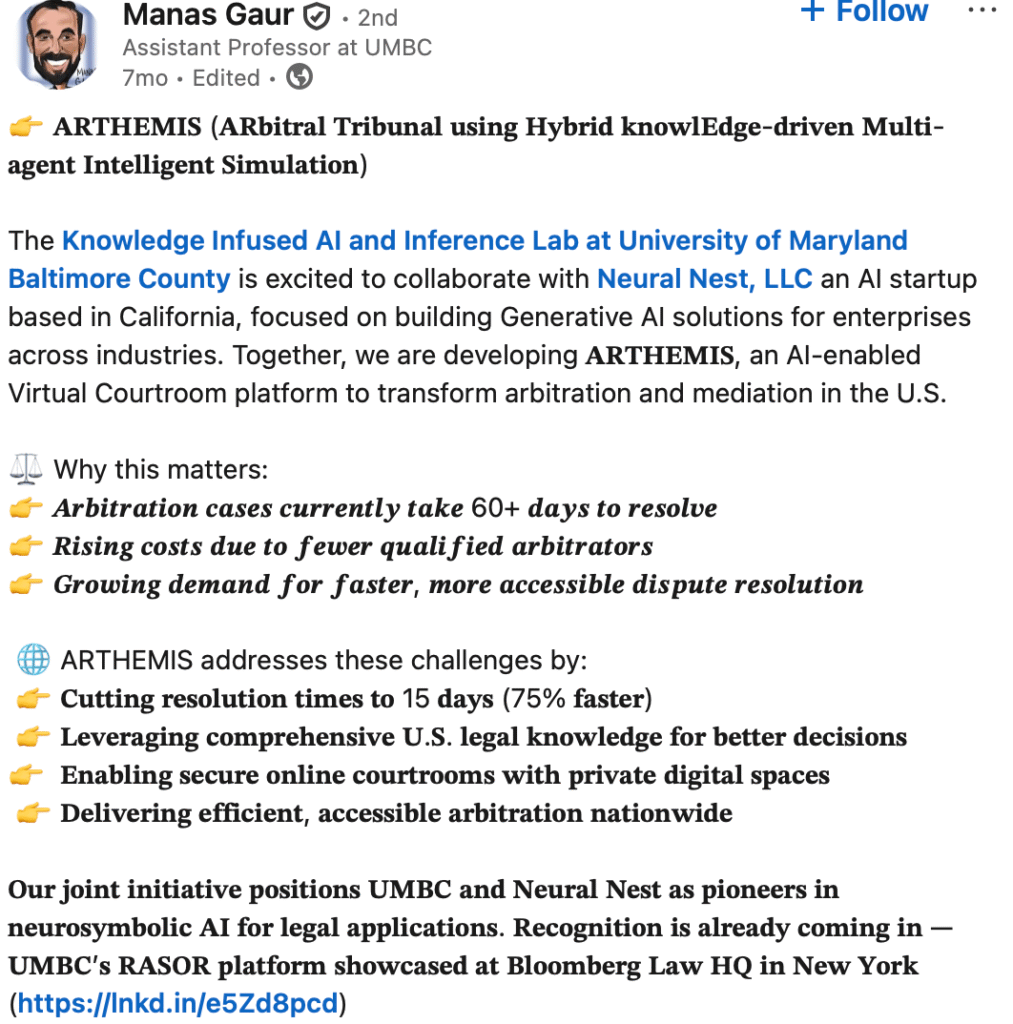
ARTHEMIS brings together multiple AI agents, legal knowledge frameworks, and secure digital environments to simulate the way arbitration actually works. Instead of a single output, the system evaluates cases from multiple angles—fact patterns, legal precedent, and contextual inputs—before surfacing structured insights. The goal is not just speed, but better decision-making.
The impact is significant: resolution timelines can be reduced by up to 75 percent, while maintaining consistency and transparency in how decisions are reached. It also expands access—enabling secure, online arbitration environments that are not bound by geography.
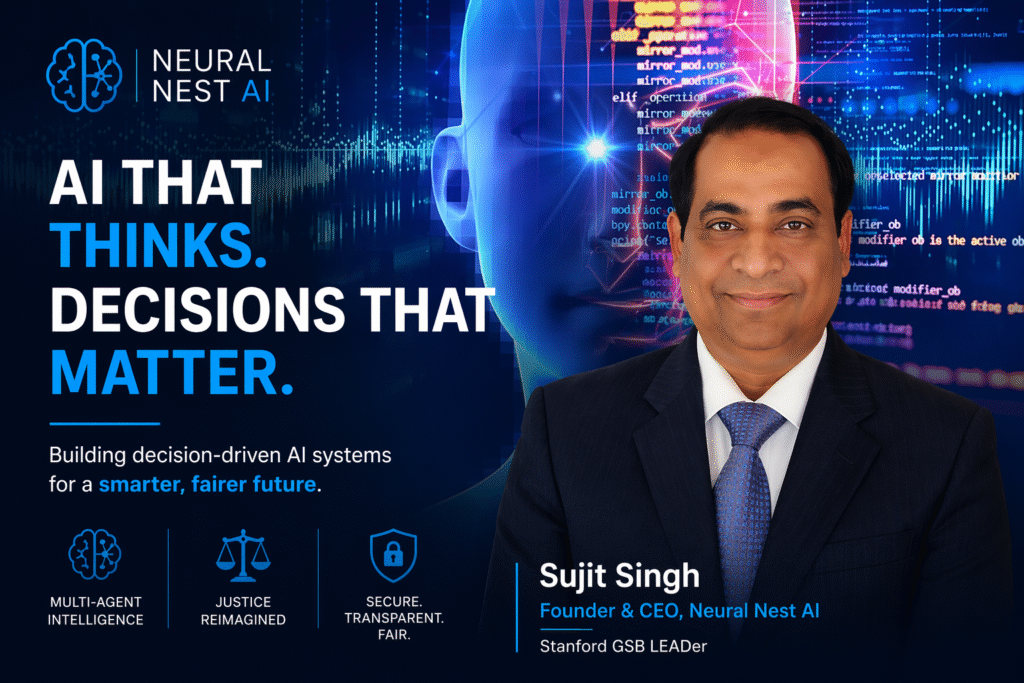
Behind this approach is Sujit Singh, whose background spans data strategy across Fortune 500 environments where decisions carry real financial and operational consequences. That experience shows up in a critical way: a focus not just on answers, but on how decisions are structured, validated, and executed.
This isn’t theoretical. In one legal deployment, teams managing more than 150,000 case documents struggled to access insights quickly. Neural Nest AI introduced a multi-agent system that allowed users to query both structured and unstructured data in real time. What once took hours could now be done in seconds—reducing reliance on IT teams and enabling faster, more informed decisions.
What Neural Nest AI is building extends far beyond legal technology. The same framework can be applied to contract negotiation, regulatory compliance, government case management, and enterprise decision workflows. In each case, the challenge is the same: move faster without sacrificing rigor.
Most AI tools generate answers. But organizations need more than that. They need systems that can weigh complexity, provide context, and support real decisions. That’s a higher bar—and it’s where Neural Nest AI is positioning itself.
There’s a difference between AI that helps you move faster and AI that helps you decide what to do next. That distinction is starting to define the next phase of this industry. Companies that focus on decision-making—not just outputs—will shape how AI is adopted across law, government, and enterprise. Neural Nest AI is already building in that direction.