



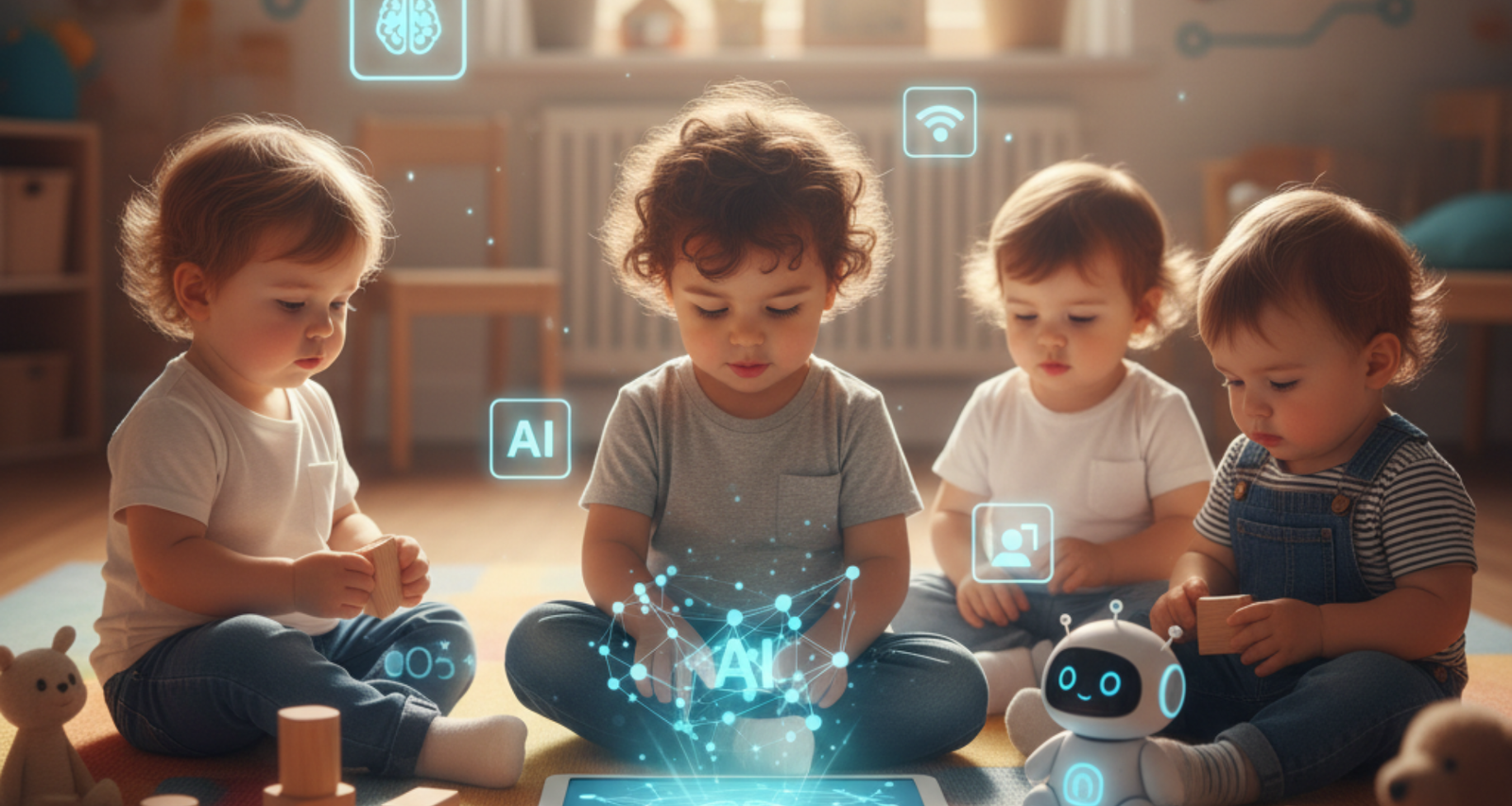
Artificial intelligence is no longer confined to labs and laptops — it’s now shaping some of the earliest years of human life. From language-learning toys to smart sleep monitors, AI is transforming how parents nurture, teach, and even communicate with children as young as 18 months old.
The shift isn’t about replacing human connection. It’s about enhancing it — giving parents better insight into their child’s development while personalizing early learning in ways that were once impossible.
From Nursery Rhymes to Neural Networks
The global market for AI-powered early-childhood tools has grown rapidly, with companies developing smart devices that adapt to a toddler’s pace, interests, and speech patterns. Interactive story apps can respond to a child’s words, while toys learn from play-time behaviors to suggest new games or songs. Behind the scenes, machine-learning models track patterns — like how often a child repeats a phrase or recognizes colors — to personalize engagement in real time.
Ying Xu, an assistant professor at the Harvard Graduate School of Education, notes that the technology can accelerate learning when designed well. “Children can actually learn effectively from AI, as long as the AI is designed with learning principles in mind,” she said in a recent interview. She added that while AI shows promise for personalization, “we don’t have answers yet” about long-term effects on child development.
Smarter Parenting, Not Surveillance
One of the fastest-growing categories is AI-assisted parenting tools — products meant to make daily routines easier and safer. Smart baby monitors now use AI-vision models to detect unsafe sleep positions or irregular breathing patterns. Other devices analyze crying sounds to interpret possible needs — hunger, discomfort, or fatigue.
Meanwhile, new apps help parents track milestones, manage pediatric updates, and generate personalized nutrition plans. For busy families, AI functions as a digital co-pilot, offering guidance instead of judgment.
Kay Firth-Butterfield, the former Head of AI and Machine Learning at the World Economic Forum, cautions that the rise of connected toys and monitors raises questions about transparency. “We are allowing our children to play with toys that are enabled by artificial intelligence but we have no understanding of what our children are learning — or where their data is going,” she said. Her warning underscores the ethical stakes of putting smart technology in children’s spaces.
Early Learning Goes Adaptive
Language learning is where AI has made some of its biggest inroads. Apps such as Lingokids and HOMER use natural-language-processing (NLP) systems to respond to toddler speech in real time — praising, correcting, or expanding on what a child says. The technology adjusts to the child’s confidence level and language proficiency, much like a patient tutor.
Research from Stanford University and MIT suggests that adaptive AI learning systems can increase vocabulary acquisition by up to 25 percent in early-childhood settings when paired with caregiver interaction.
Still, experts emphasize moderation. Too much screen-guided play can reduce unstructured, imaginative exploration — which remains the foundation of emotional and social growth.
Empathetic AI for Toddlers
The next generation of early-learning AI may not only be smart but empathetic. Developers are testing emotion-recognition models that interpret facial expressions, tone, and gestures to gauge frustration, curiosity, or joy. The goal is to create systems that respond emotionally as well as cognitively, supporting empathy and emotional awareness in young children.
That doesn’t mean AI will replace parents or teachers — but it could become a more intuitive tool for them, helping identify emotional cues they might otherwise miss.
A New Kind of Baby Book
For today’s parents, AI is quietly becoming a digital memory keeper — recording first words, first steps, and developmental milestones. The ethical questions are real: data privacy, consent, and over-dependence loom large. Yet when used thoughtfully, these tools offer something powerful — a clearer, kinder picture of how children grow.
The next chapter in AI innovation isn’t just about robots or revenue. It’s about relationships — and how technology can help the next generation learn, connect, and thrive from their very first words.
Source:
- https://www.gse.harvard.edu/ideas/edcast/24/10/impact-ai-childrens-development
- Stanford University Center on Learning Sciences and MIT Media Lab. Adaptive AI and Vocabulary Acquisition in Early Childhood Education, 2023.



3 Comments